
Hutto Neighbors Block Sources
People on a Hutto block are best researched from the parcel outward. Start with the target parcel, then inspect adjoining parcels one at a time. The public record can show a parcel boundary, listed owner, legal description, or address status. It cannot identify every person who lives nearby. Community sites may offer public board, document, and meeting information, but their account areas are not public block directories. Keep the source type visible in your notes so an owner, voter, applicant, or public contact does not become a claim about every household member.
| Block record | What it can support | Hutto access route | Boundary on use |
|---|---|---|---|
| WCAD Parcel Map | Adjacent polygons, parcel IDs, and map context | Public parcel map | Controls need live inspection and do not prove occupancy. |
| WCAD property search | Owner, situs address, account, and legal-description clues | WCAD search | Owner mailing data may point away from the parcel. |
| County GIS and Addressing | Physical location, valid address, and county or E911 context | Williamson GIS | It certifies an address, not its residents. |
| Deed and plat records | Recorded parties, lots, blocks, and subdivision history | County Clerk entry | Online field and image behavior was not verified. |
| Voter sources | A matching registration or a lawfully releasable roster | My Voter Portal or a county request | Not a complete block roster; protected records stay protected. |
| HOA registry and public sites | Association names, management certificates, public contacts | TREC registry | No member directory was located. |
Use the parcel map for geographic context, then open the matching property record. A situs address is the location being appraised. An owner mailing address can be different, and a legal description is the land identifier that can bridge to deeds. That distinction prevents a common mistake: treating a listed owner as proof that the owner, rather than another person, is currently present at the property.
Map a Hutto Block by Parcel
The documented adjacent-parcel method does not depend on an unverified radius or buffer tool. WCAD advertises property selection and data export, but the captured map interface did not expose the exact selection, buffer, measurement, or export labels. The safe method is to locate the target address, note its parcel outline and ID, zoom to the street segment, and click each adjoining polygon. Then run every recorded ID or address in WCAD instead of inferring ownership from a map label.
- Search the target street address in WCAD and keep the property or CAD ID with the situs address.
- Open the WCAD Parcel Map, locate that outline, and click each adjoining parcel separately.
- Run every adjoining parcel ID or address through WCAD, saving the owner field and legal-description terms as source-labeled notes.
- Use the County Clerk index for a recorded deed only after the parcel’s legal description gives a reliable bridge.
This flow is about the immediate Hutto block. For a named street’s longer record chain, use the Hutto address directory, where the address filters and deed trail are handled at street scale.
Note: Record the parcel ID before a name, because the identifier is less likely to change between related property searches.
Hutto Neighbors Address Layers
Three address concepts matter on a Hutto block. The situs or property address identifies the location being appraised. The owner mailing address may be elsewhere. The legal description, such as a subdivision, block, lot, tract, survey, or abstract, identifies land in a recorded instrument and can survive a changed postal description. Hutto’s city limits, ETJ, county addressing, and postal geography do not always line up, so a postal Hutto address may need a county GIS check before it is treated as city jurisdiction.
WCAD Advanced Search is useful for narrowing a street segment because it exposes street number range, street name, city, ZIP, neighborhood, property type, status, tax year, owner, and legal-description fields. The search capture did not verify a full-street browse button, historical coverage cutoff, or every result-card field. If a live parcel card visibly shows an exemption indicator, it can support a cautious owner-occupancy inference, but absence does not prove that no owner is present.
Hutto Neighbor Voter Boundaries
Voter material is a limited corroboration layer for a Hutto block. The state describes My Voter Portal inputs as name, county, date of birth, and ZIP. It is intended for a matching individual lookup, not a way to create a block list. A public result can support a registration, precinct, or district check where lawfully visible. It cannot reveal ballot choices, and it does not establish every person who lives at an address.
A fuller voter list or roster follows a different channel. Williamson County directs such requests through the County Attorney under the Texas Public Information Act, with Election Code restrictions. Early-voting and ballot-by-mail rosters are posted under the county’s stated schedule, but they are not a basis for inferring political choices. The request should be narrow and should ask the office to identify releasable fields, format, and any applicable costs rather than assuming a data set is complete.
Note: A person can be absent from voter results because of nonregistration, a move, an opt-out, or protected status.
Hutto HOA Contact Routes
Association records can identify an organization serving a block, but they are not a public list of every person nearby. The Texas Real Estate Commission registry can search by association name, county, city, and ZIP and exposes management certificates. In the Williamson and Hutto results inspected for this research, it returned Flora Residential Community, Mustang Creek Residential Community, Hutto Highlands Master Community, Mager Meadows Residential Community, The Lookout Property Owners Association, Prairie Winds Residential Community, and Hutto Town Square Homeowners Association.
The official TREC HOA registry is the right first check for an association name or management-certificate route.
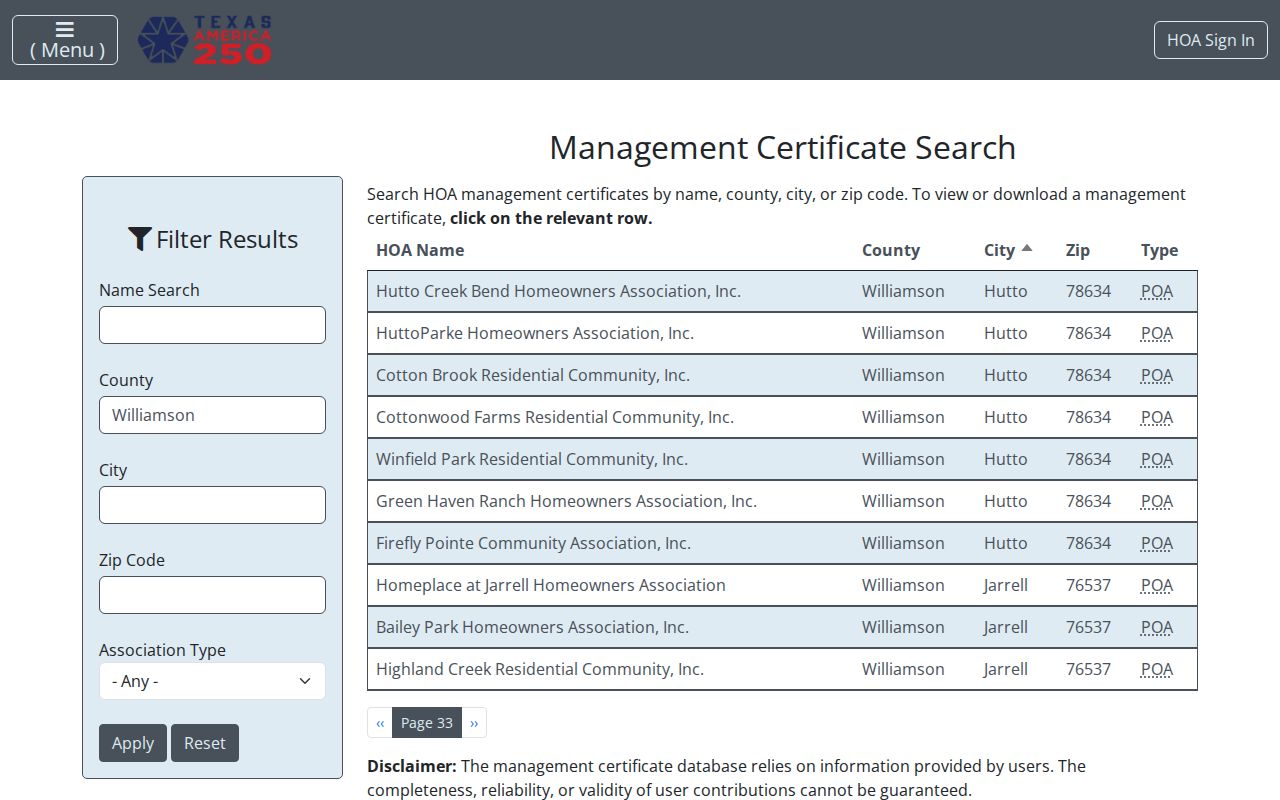
The registry result is an organization-level lead. It does not make member identities, private account details, or a block roster public.
| Association route | Public material found | Access boundary |
|---|---|---|
| Legends of Hutto HOA | News, meetings, documents, board information, and a park address | Individual account documents use RowCal login. |
| Star Ranch association portal | Bylaws, declarations, policies, maintenance agreements, and approval-plan categories | Account-specific material requires login or registration. |
| TREC management certificates | Association name and certificate search by city, county, ZIP, or association | Use the association or manager for current contact details. |
Hutto Neighbors Source Comparison
Official records and commercial neighbor tools answer different questions. A commercial compilation may merge property, marketing, court, and other data, then keep an older address after the source changes. It can also confuse similar names or omit protected records. Official sources are narrower, but they identify the custodian, record type, and access limit. Start with the official source, then treat any compiled result only as a lead that needs confirmation.
| Source type | Best use around a block | What it cannot establish |
|---|---|---|
| Official parcel and deed records | Parcel identity, recorded ownership role, and legal description | Every current occupant or a complete community list. |
| Election lookup or lawful voter file | Matching registration and election geography | Every resident, private data, or ballot choice. |
| Association public pages | Public organization contacts, meetings, and documents | Member identities or account material. |
| Commercial compiled tools | A possible lead to test with a custodian | Accuracy, timeliness, or the identity of everyone at a parcel. |
Hutto Block Records Fallbacks
When an online record does not answer the question, use the custodian’s documented channel. The County Clerk’s online official-record entry had a 403 during inspection, so do not assume its fields, image access, coverage date, or charges. The Recording Division counter at 1848 Texas Trail and a focused written request remain alternatives. Because the Clerk cannot run an open-ended search under Attorney General Opinion WW-607, provide a parcel ID, instrument number, party, date, or document type.
For city permit, code, or address-case material, GovWell is applicant-specific and no public all-address index was exposed. Use the Hutto Public Records Center for a focused request. The city may withhold confidential material or seek an Attorney General ruling. Williamson GIS Address Search can validate the physical location, and the County Clerk, Hutto Library, Round Rock Public Library, TSLAC, Baylor, or FamilySearch can help with older block context. Private association lists are not a fallback channel.
Note: A targeted request gives a custodian something searchable without asking staff to build a list of people.
Hutto Neighbor Privacy Choices
There is no universal opt-out from all lawful records. Williamson County’s voter lookup opt-out form removes an online display from the county elections website and Texas SOS lookup, but it does not remove information otherwise available under the Public Information Act. The form accepts email, fax, mail, or hand delivery through Williamson Elections and does not state a processing time. That distinction matters when someone wants less ordinary online visibility.
The Texas Address Confidentiality Program is not the same as a voter opt-out. Eligible participants use a substitute address, and their residence address, Social Security number, and driver-license or ID information are shielded from ordinary voter disclosure. Texas Election Code §13.004 also protects defined voter information. Utility customer data, driver records, and private association accounts are not public block-record substitutes.
Hutto Neighbors Lawful Use
Block research should stay limited to a lawful personal purpose, such as understanding nearby parcels, reconnecting through public contacts, or resolving a property question. Public parcel data does not erase privacy rights. Do not republish sensitive fields, infer private household details, or use information to monitor someone. Texas Penal Code §§42.072 and 42.07 address stalking and harassment. When safety is a concern, contact the appropriate official agency instead of confronting a person from a record.
Lawful use. Use these records with care and collect only the information needed for a lawful purpose. Never use a parcel, voter, court, or association record to stalk, harass, intimidate, or harm another person.
Every block result needs a source date and a plain label such as parcel owner, registered voter, public association contact, or historical clue. That simple discipline preserves the difference between a documented fact and an assumption about the Hutto block.