
Trace a Hutto Street by Address
A useful Hutto by-street search begins with the physical address, not a name. Standardize it with USPS, then use the appraisal record to find the parcel, current owner, legal description, and tax-year context. The parcel is a defined piece of land. Its situs address is the physical location used for appraisal, while the owner’s mailing address may be elsewhere. Those distinctions prevent an address result from being mistaken for proof that a named person lives at the property.
- Use the USPS address tool, then find the parcel through Williamson Central Appraisal District.
- Save the property or account identifier and the legal description. Check the county GIS search when city limits, ETJ, and a postal Hutto address do not align.
- Search the County Clerk’s official records entry for the deed that conveyed that legal description to the owner. Work from the recorded parties and instrument date, not an assumed sale date.
- Check a known individual through the official voter lookup, or make a narrow voter-list request through Williamson County Elections when allowed. A voter record is not a complete address roster.
- For an older address, ask the library or a regional collection whether a local reverse or criss-cross directory exists, then pair any result with a map, deed, or census record.
Each step answers a smaller question. The appraisal roll ties an owner to a parcel, the deed ties a transfer to land, and a historic directory can offer a dated address clue. None should be stretched into a claim about every person along a Hutto street.
Hutto Street Directory at WCAD
WCAD is the strongest public filter for a Hutto street directory search. Its basic search accepts a name, address, or property identifier and offers owner and address/account/property-ID modes. Advanced Search separates property and owner information, so a street name can be narrowed with a number range, city, ZIP Code, neighborhood, property type, status, or tax year. Use the result’s property identifier as the durable key. WCAD says its maps and data are supplied as is and may contain errors, so compare the parcel with the deed before relying on a match.
The WCAD Advanced Search capture shows the address and legal-description filters available for a focused street query.
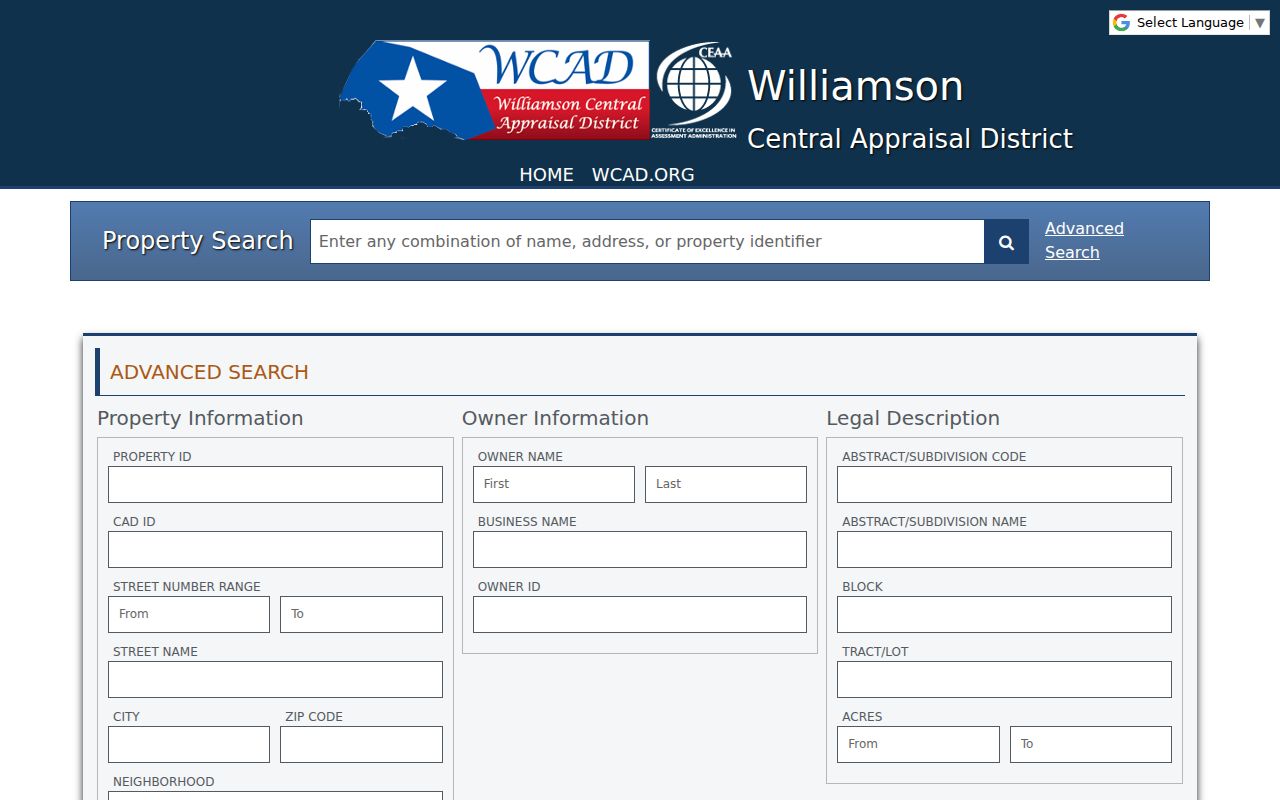
Combine a street name with a city or number range before adding an owner or tax-year filter, and retain the result’s parcel identifier for the next record system.
| WCAD search area | Visible fields | Use in a street search |
|---|---|---|
| Parcel identity | Property ID, CAD ID | Keep a stable parcel key after finding an address. |
| Street slice | Street Number Range, Street Name, City, Zip Code | Limit results to a Hutto address range. |
| Neighborhood and type | Neighborhood, Property Type, Property Status, Tax Year | Reduce a broad street result where the available values fit. |
| Owner details | Owner Name, Business Name, Owner ID | Compare a known owner with the parcel result. |
| Land description | Abstract/Subdivision Code or Name, Block, Tract/Lot, Acres | Bridge the appraisal record to a plat or deed. |
WCAD displayed a results control, but the inspected material did not expose exact sorting, export behavior, or the full status dropdown. Avoid promising filters the live portal does not display.
Hutto Address Lines and Jurisdiction
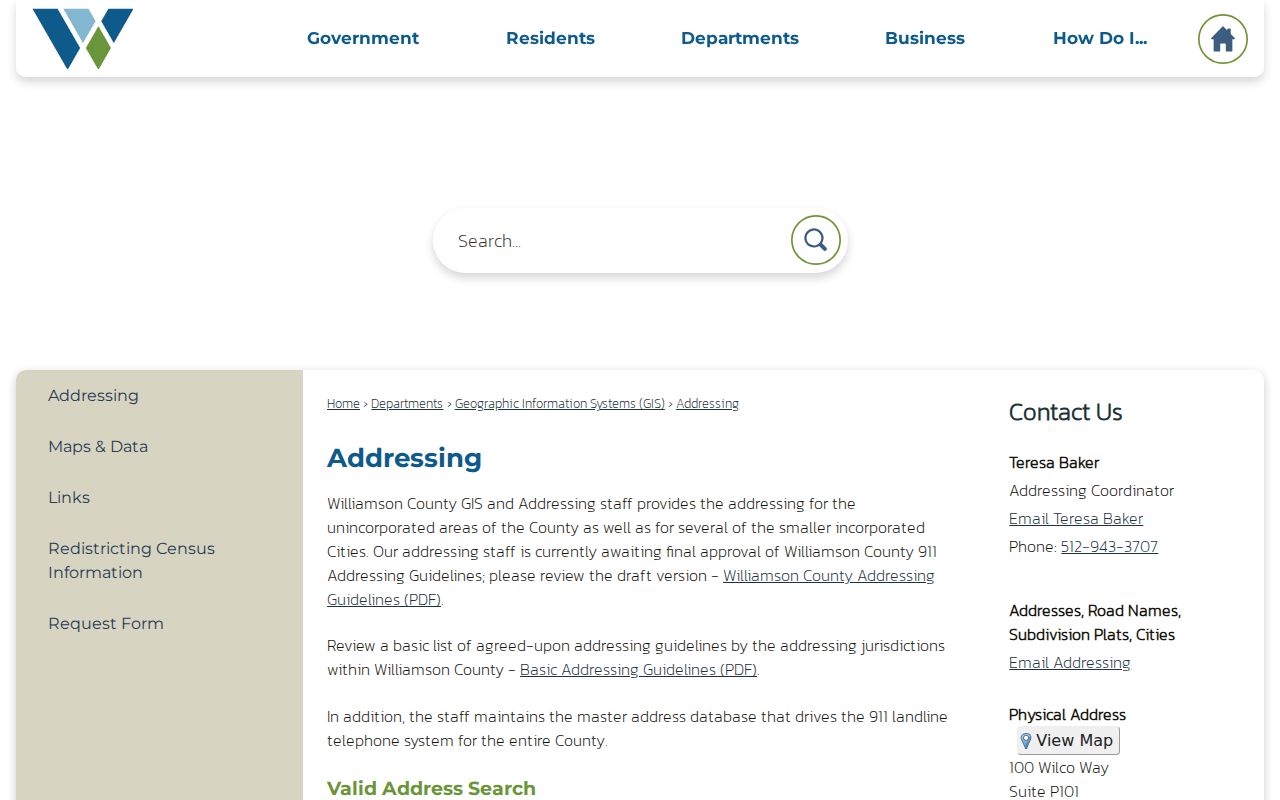
A Hutto mailing address can lead to city files, Williamson County files, or records for an unincorporated or ETJ parcel. Williamson County GIS and Addressing assigns addresses for unincorporated territory and several smaller cities, maintains the master address database for the countywide 911 landline system, and refreshes its Valid Address Search about monthly. That service can produce an address-certification letter. For the most current result, the county directs people to contact staff rather than assume a map label settles the issue.
The Williamson County Addressing capture documents the county’s valid-address and certification function.
The Hutto boundary map adds city limits, ETJ, county boundary, creeks, development agreements, and limited-purpose annexation. It explains jurisdiction, not ownership.
Note: A current county certification confirms address assignment, while a deed and parcel record establish different facts about the land.
Hutto Street Directory Record Layers
Address-keyed records do not all track the same relationship. The street directory chain starts with WCAD for parcel context, then moves to County Clerk records for transfers and plats. County GIS helps resolve the physical location. Hutto permit and code records can document a project or enforcement history when a responsive, nonconfidential record is available. Voter and directory material requires more caution because those sources identify registered voters or a dated name-and-address entry, not an entire household.
| Address record | Local keeper | What it can establish | Practical access |
|---|---|---|---|
| Appraisal parcel | WCAD | Parcel, owner, property address, legal-description search fields | Public property search and map |
| Tax statement or receipt | Tax Assessor-Collector | Current and prior-year payment context | County tax portal |
| Deed or plat | County Clerk Recording Division | Recorded transfer, party names, subdivision or lot context | Official portal entry, counter, or focused request |
| Physical address | County GIS and Addressing | Location and address certification | County GIS lookup |
| Development project | Hutto Development Services | Applicant-specific project, review, inspection, or status | GovWell account or a focused records request |
| Voter information | Texas SOS and Williamson Elections | Individual registration and precinct context, subject to restrictions | Individual lookup or a legally limited request |
Use the parcel account and legal description to bridge systems. A street name alone is useful for narrowing results, but lot and block information on a plat may be the better match once a subdivision has changed.
Hutto Street Permit Records
Permits can help date work at a Hutto address, but they are not a public occupancy roll. Hutto’s GovWell development and planning portal began on July 1, 2024. It can show an applicant, contractor, project address, plans, reviews, inspections, comments, and status for projects where the user is listed. The public cannot browse every address. That account limit matters when an address search turns up an empty portal result.
For older material or a missing project, use the Hutto Public Records Center or search the city archive by street, owner, subdivision, ordinance, permit, or address. A focused request is more workable than a request for every name on a street. Code enforcement records also require a specific request and can be partly withheld when protected information applies. The city staff directory lists code enforcement at 512-759-5994.
Hutto Street Deed Records
The deed chain follows land, not a postal string. Start with the WCAD owner and exact legal description, then use the County Clerk search-records page to reach the official records entry. Find the deed in which the current owner is the grantee, copy the prior grantor and legal description, and repeat backward through recorded transfers. Instrument numbers and recording dates make it easier to ask for a particular record if an index result is unavailable.
- Parcel
- A defined piece of land in the appraisal system, usually identified with an account or property identifier.
- Situs address
- The physical property location used for appraisal. It is different from an owner’s mailing address.
- Plat
- A recorded map that divides land into lots, blocks, streets, or a subdivision layout.
- Criss-cross directory
- A reverse directory arranged by address, used to look for a dated occupant where a local run is confirmed.
The County Clerk’s Tyler portal returned a 403 during research, so its public field labels, image access, fees, result limits, and online start date were not verified. The fallback chain is the Recording Division counter at 1848 Texas Trail, a focused written request, a courthouse research visit, FamilySearch historical books, TSLAC, Baylor’s Williamson County material, or a title professional for a formal title search. County Clerk staff say they cannot perform open-ended searches under Attorney General Opinion WW-607.
Hutto Street Names Through Time
Historic Hutto street research needs a map and legal-description bridge. James Emory Hutto filed the town plat at the Williamson County Courthouse in 1877, followed by additional plats in 1884 and the 1890s. The original plan placed six blocks and 98 lots between Front Street and Austin Avenue, west of the railroad crossing at present Jim Cage Lane. East Street, Farley Street, FM 1660, and county-road descriptions can also appear in records from different periods.
There is no verified local renumbering or street-renaming event in the inspected official sources. Do not create a number-conversion story from a similar street name. Instead, compare intersections, a plat, the survey or abstract, block and lot, a deed, the county certification, and the 1921 Hutto Sanborn sheet. The map can show whether a downtown building footprint, street name, or use existed in that year, but it cannot identify a modern household.
Note: Preserve the original legal description when tracing a parcel, because rewriting every older reference into a current address can erase evidence.
Hutto Street Directory Myth
One address result does not create a list of everyone on a block. An appraisal roll generally tracks an owner and parcel. A recorded deed tracks parties to a land transaction. A permit can name an applicant or contractor. A voter result concerns registration, and a historic reverse directory is only a dated entry when a local volume is available. Each record can be valuable, but the fields are not interchangeable.
The practical rule is simple: label a finding by source and date. When an owner’s mailing address differs from the situs address, it does not establish who occupies the parcel. When a name is absent, the absence may reflect a different custodian, a protected record, a spelling difference, or no relevant record at all.
Hutto By-Street Voter Limits
The Texas My Voter Portal is an individual lookup, not a street browser. Research found inputs for name, county, date of birth, and ZIP, with VUID or Texas driver-license alternatives described in county training material. Its public result fields were not fully exposed during inspection. Williamson Elections handles voter-file and roster requests through a narrow Texas Public Information Act request, while election law restricts defined confidential information.
Texas does not register voters by party, and a lookup cannot reveal ballot choices. The county’s voter opt-out form can remove a record from the county elections website and the state lookup, but not from information otherwise public under the Act. Use a known name for a personal record question, and ask Elections to explain the current scope, restrictions, and any quoted charge for a specific records request.
Hutto Street Directory Privacy Limits
Address records cannot supply motor-vehicle addresses, utility customer lists, delivery-route information, protected voter data, or every household member. Federal driver-privacy rules restrict motor-vehicle address data. Texas Election Code Section 13.004 protects Social Security numbers, driver-license or ID numbers, and defined confidential voter information. A permit applicant may be an owner’s representative, a contractor, or an entity. A county address certification confirms assignment, not residency.
Texas also has source-specific protections. The Williamson voter opt-out is not the same as the Texas Address Confidentiality Program, and an ACP substitute address is not a deletion of a recorded deed. Contact the custodian that created a record to correct it: WCAD for appraisal data, the County Clerk for an instrument issue, Elections for voter information, and the court clerk for docket questions.
Lawful use. Use Hutto address records for a personal, lawful purpose such as family history, property context, or civic research. Texas law prohibits stalking and harassment, and protected addresses should not be republished or used to intimidate anyone.